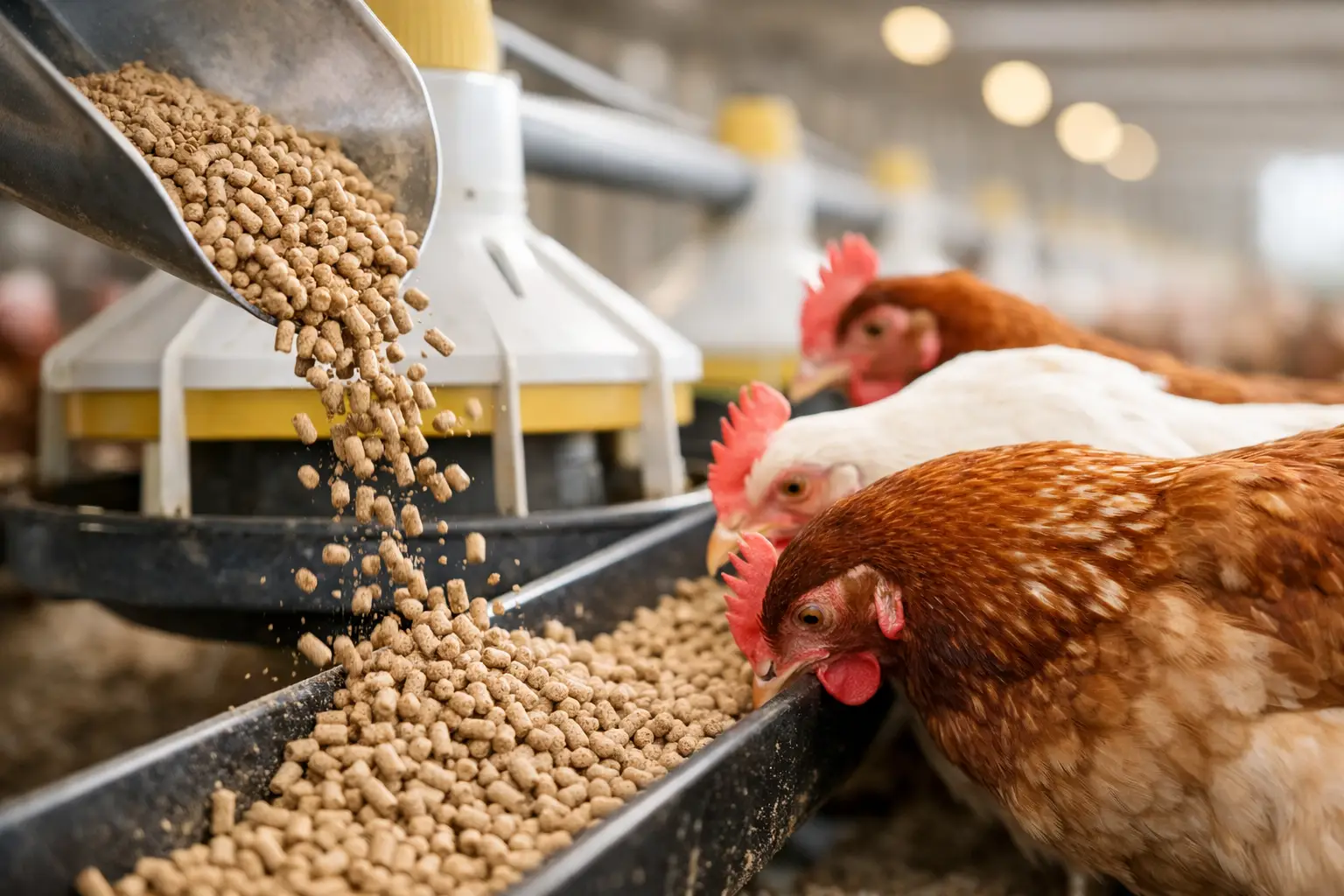

A handful of corn scattered at the right time can bring hens running across the garden. Given too freely, though, it can also be the reason they leave their proper ration behind.
If corn is being offered as an extra, later in the day is generally more practical, after the birds have had plenty of opportunity to eat their normal complete feed. That helps keep corn in its proper place within the feeding routine rather than allowing it to replace a balanced ration.
When Should Chickens Eat Corn?
For most garden flocks, corn is best offered later in the day once the birds have already had good access to their main feed.
For laying hens, that will usually be a suitable layers’ feed such as pellets, mash or meal. These feeds are formulated to provide the main balance of nutrients required by the flock.
Corn can then be offered as a small extra in the afternoon or early evening. It can also be useful for encouraging birds back towards the run or coop area and gives them something to scratch for.
There is no need to wait until dusk. The important point is simply that corn should come after the birds have had the opportunity to eat their normal ration.
Why Corn Should Be an Extra
Maize and mixed corn are useful sources of dietary energy, but they are not complete feeds for laying hens, growers or chicks.
A complete poultry ration provides a much broader nutritional balance than grain alone. If birds fill up on corn first, they may eat less of the feed that should form the basis of their diet.
This does not mean corn needs to be avoided. It simply needs to be kept in proportion.
A useful practical check is to watch what happens at the main feeder. If hens regularly leave their normal feed while waiting for corn, reduce the amount being offered.
Is Evening Corn Better in Winter?
Corn is often associated with winter feeding because it provides additional dietary energy, but it should not be relied upon as a way of keeping chickens warm.
Suitable housing, dry bedding, shelter from wind and rain, clean drinking water and enough appropriate feed remain much more important parts of winter management.
A modest afternoon feed of corn can still fit comfortably into a winter routine, provided it does not reduce the amount of complete feed the birds are eating.
A Simple Daily Feeding Routine
Make the main poultry feed available from the morning onwards and ensure all birds can reach it comfortably.
Later in the day, offer a modest amount of corn on clean ground, in a shallow tray or scattered through dry litter so the birds can scratch for it.
Only put down what the flock is likely to clear. Grain left lying around can become damp, contaminated or attract rodents.
Fresh, clean water should always be available.
Birds that eat whole grains, vegetation or other fibrous material may also need access to suitable insoluble poultry grit. Grit is different from oyster shell or other calcium sources, which serve a separate nutritional purpose.
Does the Amount of Corn Change Through the Year?
Feed intake naturally changes with weather, breed, activity levels and how much the birds are ranging.
During colder periods, birds may use more energy and a little corn later in the day can be a useful addition. In hot weather, when appetite can be lower, it becomes even more important not to allow treats or grain to displace the birds’ main ration.
Free-ranging birds may also find insects, seeds and vegetation, but this should not be treated as a substitute for a suitable complete feed.
What About Chicks and Growers?
Young chicks should have an appropriate chick crumb or starter feed as the basis of their diet.
As they develop, they should move on to a suitable growers’ ration before eventually progressing to an adult feed at the appropriate stage.
Corn should not be used in place of those stage-specific feeds. Young birds have different nutritional requirements from adult laying hens, so their main ration matters more than adding grain as an extra.
Whole Maize or Kibbled Maize?
Whole maize is larger and gives adult birds more work to do when eating it, while kibbled or cracked maize has been broken into smaller pieces.
Kibbled maize can therefore be easier for smaller birds to manage and can also be useful where you want the grain to be eaten more quickly.
Whichever form is being used, it should still be offered as an extra rather than replacing the flock’s main feed.
Mixed Corn Is Not the Same as Maize
Mixed corn usually contains more than one grain, commonly including wheat and maize, although the exact blend varies from product to product.
It is still a scratch feed rather than a complete ration, so the same rule applies: offer it after the birds have eaten their main feed and keep the quantity sensible.
How to Tell if You’re Feeding Too Much Corn
Watch the flock rather than relying only on a scoop or fixed amount.
If hens are eating their normal feed steadily, clearing the small amount of corn offered and maintaining normal condition, the balance is probably about right.
If they become selective, leave pellets or mash behind or spend much of the day waiting for corn, reduce the amount and put the emphasis back on the complete feed.
Offering corn later in the day is a simple way to keep it separate from the flock’s main ration while still giving the birds something to scratch for and enjoy.
Keep an appropriate complete feed at the centre of the routine and use corn as a measured extra rather than a replacement.
Frequently Asked Questions
Can chickens eat sweetcorn?
Yes, plain cooked sweetcorn can be offered occasionally in small amounts. Avoid sweetcorn prepared with salt, butter, sauces or seasoning, and treat it as an extra rather than part of the main ration.
Is mixed corn the same as maize?
No. Maize is a single grain, while mixed corn usually contains a combination of grains such as wheat and maize. The exact mixture depends on the product.
Can bantams eat whole maize?
Some bantams manage whole maize without difficulty, but smaller birds may find kibbled or cracked maize easier to handle. Watch how the birds are actually eating it and choose the form that suits the flock.
Can corn be mixed into layers’ pellets?
It can be mixed in small amounts, but keeping corn separate often makes it easier to see how much of the complete ration the birds are eating. The layers’ feed should remain the main part of the diet.
Can chickens eat corn straight from the cob?
Adult chickens can peck plain corn from the cob as an occasional extra. Avoid seasoned or buttered corn and remove any uneaten material before it becomes dirty or spoiled.
Is cracked corn the same as kibbled maize?
The terms are often used for maize that has been broken into smaller pieces rather than left whole. The exact size can vary between products, so check the product description if size matters for your birds.
Can free-range hens still be given corn?
Yes. Free-ranging hens can still be offered corn in moderation, but the food they find while ranging does not replace the need for an appropriate complete ration.